
Amazon Music HD Has Great Sound Quality and a Pretty Solid Lineup
This article was automatically translated from Japanese by AI. Read the original Japanese version →
Table of Contents
Recently, Amazon Music HD was running a 3-month free campaign, so I decided to sign up (?) and give it a try. The sound quality is great and I've been finding it quite convenient, so I thought I'd write up a brief introduction and review.
A Quick Introduction

It's the high-resolution audio tier of the music subscription service Amazon Music Unlimited. As the name suggests, it's an Amazon service, and one notable perk is a slightly discounted rate if you're an Amazon Prime member. Other than that, there aren't many standout quirks—the overall experience is pretty much the same as YouTube Music or Spotify.
Sound Quality
Sound quality is Amazon Music HD's main selling point.
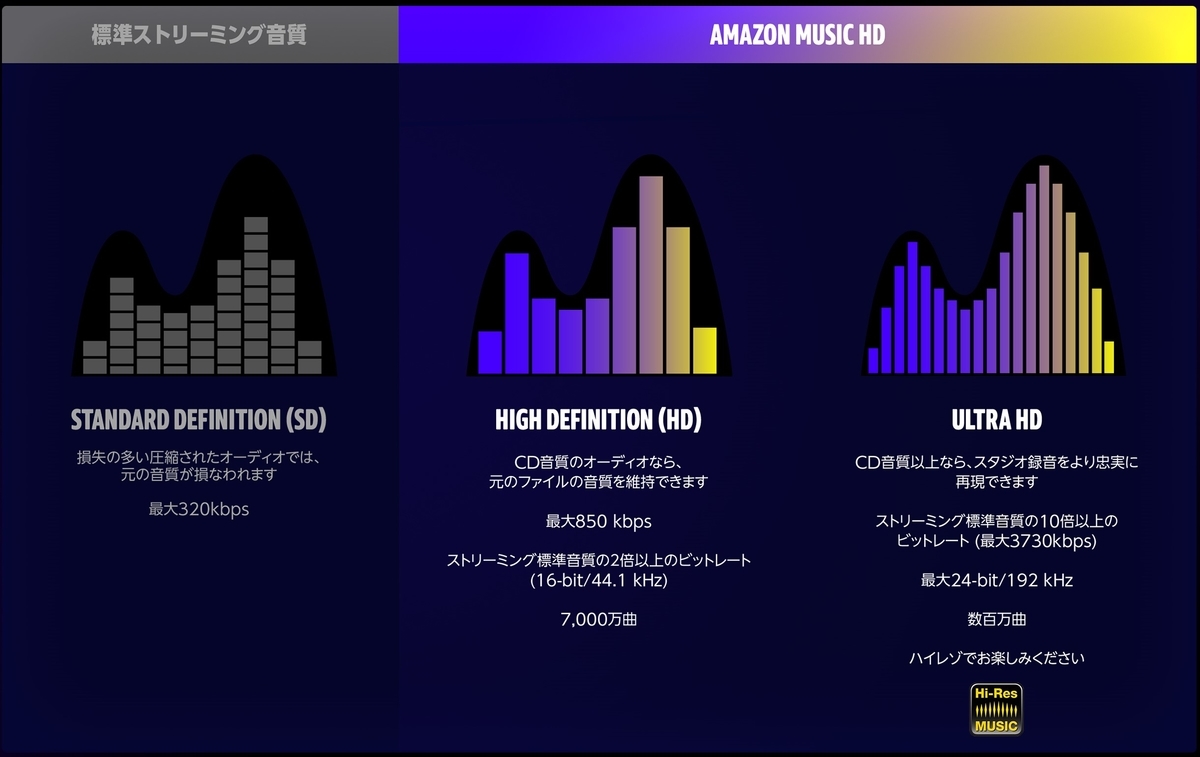
The 320 kbps Standard (SD) tier shown on the left is roughly on par with the highest audio quality offered by Spotify and YouTube Music—so it's not like Amazon Music's SD is unusually bad. That means HD genuinely streams audio at more than double the bitrate. It primarily uses lossless FLAC. From what I've seen, almost every track on Amazon Music is available in HD.
ULTRA HD refers to what's commonly called Hi-Res audio, though Amazon Music seems a bit reluctant to use the term "Hi-Res" and labels it ULTRA HD instead. It's advertised as up to 24-bit/192kHz, though in practice, tracks that are actually 24-bit/192kHz still feel fairly uncommon. On the flip side, there's a surprisingly decent number of tracks at around 24-bit/96kHz. Even at that level, it surpasses CD quality (16-bit/44.1kHz), so it gets classified as ULTRA HD.
Over Wi-Fi, I rarely ran into buffering delays even when playing ULTRA HD tracks. Streaming it over 4G would understandably be rough, so you'll want to download tracks in advance if you're listening on the go.
Whether the songs you listen to are available in ULTRA HD depends a lot on the genre, so it's hard to generalize—but there is a way to check beforehand, which I'll get to in a moment.
About the "ULTRA HD" Label
Amazon Music is probably the only service using the label "ULTRA HD." There's a reason they don't just call it Hi-Res, as briefly touched on in the article below.
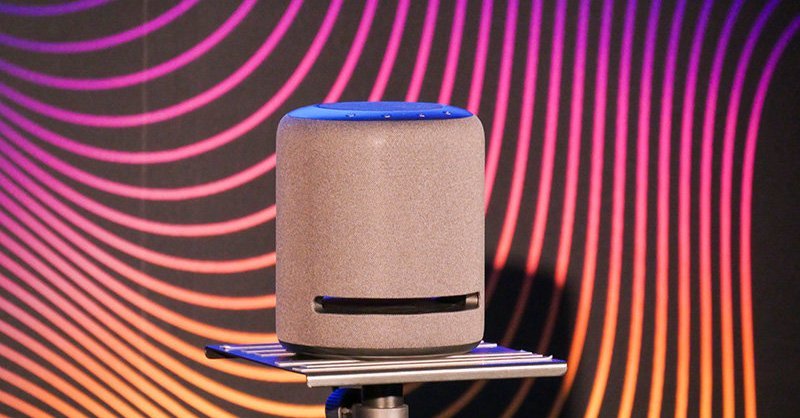
"When we surveyed consumers, the response we got was that they didn't know what terms like 'Hi-Fi' or 'Hi-Res' even meant," said Vice President Boom.
"When we asked if they understood the word 'HD,' they said, 'We know HD from video resolution.' And 'ULTRA HD' immediately came across as 'something even better than HD.'" (VP Boom)
To begin with, "Hi-Res" just means audio quality higher than CD, and the exact definition of which formats qualify is actually pretty vague.
Amazon Music HD's top spec of 24-bit/192kHz is probably what most people picture when they hear "Hi-Res," but in reality there are plenty of tracks distributed in formats lower than 24-bit/192kHz while still above CD quality—24-bit/96kHz is quite common.
I figure Amazon just decided it wasn't worth the hassle and lumped all of that under ULTRA HD.
Lineup
At the very least, the lineup of HD-compatible tracks doesn't fall short of competing services at all. ULTRA HD availability does skew heavily by genre, though there's a way to check whether the music in your particular niche (?) is available in ULTRA HD without actually subscribing to Amazon Music HD.
You can check dedicated Hi-Res download stores. The big ones are mora, e-onkyo music, and OTOTOY.

Hi-Res Audio Store [e-onkyo music]e-onkyo.com

For the most part, tracks available on these sites can also be found on Amazon Music HD. Very few artists go out of their way to restrict their hi-res releases to just one store.
If you use these sites to check whether your favorite artists even distribute Hi-Res audio before signing up for Amazon Music HD, you won't end up disappointed by a lack of ULTRA HD tracks.
Drawbacks
The upside—great sound quality—is simple and easy to understand, but there are also a few downsides, mainly when comparing it to Spotify.
First, the auto-generated mixes are lacking. Compared to Spotify or YouTube Music, there's way less going on—in fact, there's only the weekly Discovery Mix and nothing else.
Some people might really miss Daily Mixes, though those didn't exist before Spotify popularized them anyway, so I think you can get by without them.
Second, it's simply expensive. Even for Prime members, it's ¥1,780/month, or ¥17,800/year. Considering Spotify is ¥980/month or ¥9,800/year, that's roughly 1.8x the price. It comes down to how much you're willing to pay for sound quality.
Third, given the sheer amount of audio data, you pretty much end up using wired earphones or headphones. Maybe that's not strictly an Amazon Music issue, but with current technology, standard Bluetooth tops out around 320 kbps, and even SONY's LDAC codec has a theoretical max of 990 kbps. If you're listening on ordinary Bluetooth earbuds, you probably won't notice much difference between Amazon Music HD and Spotify.
Put another way, people using Bluetooth earphones won't get much of the benefit from Amazon Music HD. That's definitely worth thinking through before subscribing. Personally, I switched to using wired earphones at home.
You should also double-check whether your smartphone and playback gear actually support Hi-Res audio. PCs generally support the formats out of the box (noise and DAC quality aside). For Android phones, it varies by model so it's worth checking. I'm not too sure how things stand on iPhone.
Summary
So that's my review of Amazon Music HD. At the end of the day, it's a question of how much you're willing to pay purely for better sound quality, but I ended up liking it quite a bit and plan to keep using it after the free trial ends.
By the way, if you want to stream Hi-Res audio via a subscription in Japan, mora qualitas is another option—in fact, these two are basically the only choices.
mora qualitas - High-Resolution Streaming Servicemora-qualitas.com
I don't have plans to try mora qualitas right now, though I'd like to check it out if I get the chance.
That's all for today.