
VR Games Following in Gorilla Tag's Footsteps
This article was automatically translated from Japanese by AI. Read the original Japanese version →
Table of Contents
The world of VR (virtual reality) is evolving every single day. With each new piece of hardware, we are able to immerse ourselves in virtual worlds more deeply and intuitively than ever before. Yet truly groundbreaking experiences aren't born from better tech specs alone. They emerge when someone truly understands the nature of VR as a medium and invents a completely new way to move our bodies.
Released in 2021, the seemingly simple game Gorilla Tag did exactly that. Its locomotion system—moving solely through the motion of your arms—was both primal and revolutionary, sending shockwaves through the VR player base. It didn't just change how we get around; it taught us the fundamental joy of physically running and leaping through a VR space using our own bodies.
Its impact has been massive. Since Gorilla Tag's success, a wave of follow-up titles inspired by its signature feel—often called "arm movement"—has emerged, forming a major trend and a genre of its own within VR gaming. Rather than stopping at mere imitation, these games have brilliantly adapted the physicality of the original into diverse genres like platformers, fighting games, and action adventures.
In this post, I want to revisit Gorilla Tag itself—the game that opened up a new frontier for VR—and introduce some fascinating "Gorilla Tag followers" that inherited its DNA and evolved in their own directions, along with my personal play impressions and reviews.
1. Where It All Began: Gorilla Tag
Reinventing the Primal Game of Tag
Gorilla Tag is a VR multiplayer game developed by Another Axiom. Players take on the avatar of a low-poly gorilla with only a torso, head, and arms, playing an endless game of tag with other players across sprawling, jungle-gym-like maps.
The rules are dead simple. The tagged player (known as a Lava Monkey, glowing fiery red like molten lava) wins by touching survivors to turn them into Lava Monkeys until everyone is tagged. Survivors win if they manage to evade the Lava Monkeys until the timer runs out. There are several game modes, but this straightforward game of tag is the foundation—and the core hook that keeps so many players hooked.
Rather than explaining it in words, it's best to just watch its kinetic gameplay in action.
As you can see from the footage, there are no cutting-edge graphics or intricate story here. Yet the game possesses an intense charm and addictiveness unmatched by almost any big-budget VR title. The source of that magic is its groundbreaking locomotion system, which completely overturned conventional wisdom about movement in VR.
Player Numbers and Milestones: A Historic VR Hit
The appeal of Gorilla Tag wasn't limited to critics or a niche hardcore crowd. Driven largely by word of mouth, its popularity exploded into an extraordinary commercial success—almost unheard of for a VR game.
In June 2024, VR outlets reported staggering numbers for Gorilla Tag, cementing its place as one of the biggest hits in VR history:
- Lifetime players: Over 10 million
- Total revenue: $100 million (over 15 billion yen)
- Monthly active users: 3 million
- Daily active users: 1 million
(Sources: Road to VR, UploadVR)
$100 million in revenue puts it among the most successful single VR games of all time. What makes this especially astonishing is that the game started as a free-to-play title (launching into full release after an Early Access run on App Lab) and achieved these numbers primarily through in-game cosmetic purchases. It's undeniable proof that the core fun of the gameplay drew in millions of players and fostered a massive, thriving community.
Sitting perpetually near the top of the Meta Quest Store's top-selling charts, it has established itself as the go-to "first game to try" for countless VR users. Its success proved that on VR platforms, pure "physical fun" can be just as massive a business opportunity as graphical fidelity or narrative depth.
Moving with Only Your Hands: The Shock of "Arm Movement"
What makes Gorilla Tag a true turning point in VR history is its utterly unique control scheme: moving solely with your hands and arms.
In most traditional VR games, movement is handled with the controller's analog stick. While simple and familiar, the disconnect between your physical stillness and your virtual motion frequently causes VR sickness. Teleportation movement also became widespread to reduce motion sickness, though it comes at the cost of freedom of movement and some immersion.
Gorilla Tag chose a third path altogether. Players use their real arms to push off the ground and walls, propelling themselves forward—just like a real gorilla knuckle-walking. When climbing a wall, you reach up and pull yourself upward hand-over-hand.
At first, this feels surprisingly difficult. Most players spend their first few minutes flailing awkwardly across the ground. With practice, however, your brain and body quickly adapt to this new way of moving. The harder and faster you push off the ground, the farther and faster you launch yourself. You can kick off walls to bounce back and forth, or leap from tree branch to tree branch. Once all these complex maneuvers come together through nothing more than the swing of your own arms—no sticks or buttons required—you get an unprecedented sense of freedom and agency, as if you truly command the space around you.
This locomotion system also came with a major bonus: it dramatically reduces VR sickness. Because your physical motions match your in-game movement almost one-to-one, your brain rarely gets confused. As a result, despite the intense, fast-paced action, most players can play comfortably for long stretches.
The trade-off, of course, is serious physical exertion. Play for 30 minutes and your shoulders and arms will be burning, drenched in sweat. It starts feeling less like "playing a video game" and more like "picking up a new sport." Yet that satisfying fatigue is right at the heart of the Gorilla Tag experience and the reason so many players fall in love with it. This fusion of physicality and immersion was a brilliant invention—one that went on to inspire a whole wave of successors.
2. Evolving into a Classic Platformer: No More Rainbows
The arm movement pioneered by Gorilla Tag proved its free-flowing, dynamic potential within the simple rules of tag. So what happens if you take that intuitive, physical locomotion and channel it into tighter, more structured game design? One compelling answer comes from Squido Studio's No More Rainbows.
This is a full-fledged 3D action platformer built around Gorilla Tag-style controls. It even has a delightfully tongue-in-cheek premise: you play as a beast from the underworld invading a rainbow world full of cute characters to strip the color back out of their cheerful lands.
The very first thing that came to mind while playing it was the Nintendo 64 classic Super Mario 64. You explore sandbox-style stages toward a goal, hunting down hidden collectibles and overcoming all sorts of obstacles along the way. The structure is pure classic 3D platformer—yet swapping out traditional controls for VR arm movement elevates it into an entirely new dimension.
I even posted a review of it on Steam myself—I can vouch for how good it is.
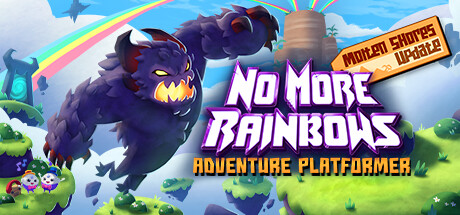
There's a clear reason I called it a "classic platformer" and "like Super Mario 64" in that review.
In Gorilla Tag, movement is primarily about tearing through wide-open spaces freely and at high speed; in a game of tag where every inch counts, that raw momentum is the main attraction. In No More Rainbows, however, that same movement style is repurposed for classic platforming challenges like landing on tiny ledges and dodging hazards.
How hard you push off the ground, the angle of your swing, your timing—all of it is needed to finely control the height and distance of every jump. When hopping from one narrow platform to the next, you aren't tilting a thumbstick; you're adjusting the swing of your own arms down to the millimeter. Climbing walls isn't just about going straight up, either—you have to traverse sideways to dodge traps or let go at just the right moment to leap onto an adjacent wall.
This sense of "physical precision" is the game's greatest charm. Unlike pressing a jump button on a gamepad, your own physical coordination translates directly into your character's movement. It makes you feel as if you really are a superhuman beast tackling an elaborate obstacle course.
The stage design is stellar as well. Exploring every nook and cranny for hidden collectibles and figuring out routes to seemingly unreachable spots captures the exact thrill of chasing Power Stars in Super Mario 64.
By marrying the physicality of Gorilla Tag with tight level design, No More Rainbows delivers one of the definitive forms of the 3D platformer in VR. You could call it a next-generation Mario experience that tests both your arm strength and spatial awareness.
3. Pure Brawling Thrills: Underdogs
Nimble traversal isn't the only thing arm movement is good for. Those powerful swings can just as easily unleash something rougher, fiercer, and far more destructive. Underdogs, developed by One Hamsa, leans into that exact potential.
It's a VR mech-brawling action game where you pilot a hulking mechanical rig and slug it out in underground arenas. And both moving your mech and fighting in it are driven entirely by arm movement.
You pull yourself across the arena floor just like in Gorilla Tag to close the distance on an enemy, then carry that momentum straight into a haymaker, slamming gigantic iron fists into their armor. You can grab an enemy's limb, rip it clean off, and beat them with the wreckage. It's primal, brutal, and outrageously exciting mech-on-mech mayhem.
I was hooked the moment I played this one too, and wrote a Steam review for it as well.
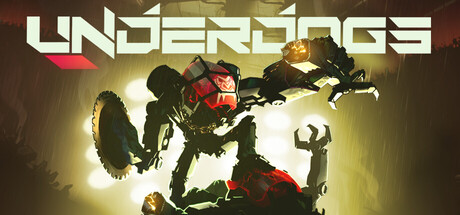
Anyone who has played Gorilla Tag has probably sensed the aggressive, smash-everything potential behind swinging your arms around like that. Haven't you ever thought that kind of arm movement would actually be a natural fit for a fighting game? Underdogs makes that hunch feel inevitable, turning an instinct everyone shares into a brilliantly realized game.
What stands out most is how seamlessly movement and combat flow together. You take a running start by pulling yourself forward with huge arm strokes, then channel all that kinetic energy directly into your punch. That entire sequence comes straight from your own physical motion. Pressing one button to dash and another to punch can't hold a candle to this level of immersion. Because swinging harder makes both your movement and your strikes stronger, you naturally end up throwing your whole body into it.
Footwork has always been an unsolved headache for VR fighting games, since thumbsticks just don't give you fine control over spacing. Underdogs solves this with a stroke of genius: the idea of "just doing your footwork with your hands too."
Deepening the appeal even further are extensive mech customization options and a roguelite career mode built for replayability. Winning bouts earns you new parts and weapons, letting you refine your own combat style. This progression adds strategic depth on top of the physical brawling, keeping you coming back to the arena again and again.
Sitting inside a mech cockpit also works wonders as a VR design choice. The cockpit frame naturally anchors your field of view, helping prevent VR sickness even during frantic brawls, while your arm motions stay directly synced to the mech's arms so you never lose the feeling of piloting a massive machine.
Physics-driven combat also makes every fight play out differently. You can parry an incoming blow with your forearm and slam a counter into an exposed torso, or grab onto enemy plating, wrench it off, and smash the core inside. Rather than trading canned hit animations, these interactions turn your own creativity and physical motion directly into combat results.
Underdogs proved that arm movement isn't just a locomotion gimmick—it can serve as the backbone of a visceral, intuitive combat system.
4. Uncharted Potential: Animal Company
If No More Rainbows and Underdogs represent specializations of Gorilla Tag's DNA into specific genres, then Animal Company is an ambitious title trying to push that potential into a broader action-adventure space.
At the moment, it is only available on Meta Quest and doesn't have a PCVR version, so unfortunately I haven't had the chance to play it myself yet. Even so, the phenomenon it's kicking up on the Quest Store is impossible to ignore.
Judging from trailers and the store description, it takes Gorilla Tag's movement feel and layers combat, expansive map exploration, and strong horror elements on top. Players team up to explore and survive in a mysterious world prowled by eerie creatures.
Why I'm Watching It Closely Despite Not Having Played It
There's a concrete reason I felt compelled to highlight this game even without playing it: it has remained camped out near the top of the Meta Quest Store's bestseller charts for a remarkably long stretch.
In the VR market—especially on a curated platform like Quest—it's no small feat for an indie title to become a top-selling regular. That staying power proves it's no mere Gorilla Tag clone, but something with a potent hook of its own that keeps players coming back. Its huge volume of user reviews speaks to just how passionate the community has become.
Why has Animal Company resonated so strongly? It may be presumptuous to speculate without playing it, but a few factors stand out.
First is the sheer joy of exploration enabled by Gorilla Tag's freeform movement. While the original focused strictly on tag, here the sprawling, mysterious world itself is the playground. Using arm movement to scale towering heights nobody has reached before or slip into hidden passages must feel exhilarating.
Second is the pairing of co-op and horror. Facing terrifying monsters you could never handle alone forces you to coordinate with friends. Arm movement becomes your lifeline—both for scrambling away from danger and for rushing in to rescue a teammate. When physical locomotion meets co-op play under real tension, it naturally creates an intense sense of camaraderie and excitement.
And third is the steady expansion of the world through ongoing updates. Launched in Early Access, the dev team has been actively adding new content to keep the experience fresh.
Animal Company hints that arm movement isn't just a standalone mechanic—it can serve as the foundation for richer, more complex, story-tinged game worlds. I'm personally hoping for a PCVR port, and there's no doubt it's a key title for seeing where this movement goes next.
Wrapping Up
The stone Gorilla Tag tossed into the VR pond has grown into huge ripples spreading across the entire platform. By putting one of humanity's simplest motions—swinging your arms—at the center of movement, VR gaming stepped into a new dimension of physicality and immersion.
The games we looked at today are different developers' answers to that brilliant invention:
- No More Rainbows elevated that physicality into precise platforming action, rebuilding the magic of classic 3D platformers inside VR.
- Underdogs channeled forceful arm swings into intuitive, destructive mech brawling, delivering an unmatched visceral rush.
- Animal Company turned that freeform traversal into the backbone for thrilling co-op expeditions into an unknown world, captivating huge crowds of players.
The existence of these follow-ups proves Gorilla Tag's success was no fluke. Arm movement has grown into a full-fledged subgenre of its own, continually sparking fresh ideas among VR creators.
Where will this trend go from here? Maybe we'll see sports games paired with even sharper physics simulations, or narrative adventure games where physical traversal deepens the storytelling.
One thing is certain: breaking a sweat while racing across a virtual world is a joy you can never get from pushing a thumbstick, and it remains one of the most valuable experiences VR has to offer. Gorilla Tag and its followers will be remembered in VR gaming history as the pioneers that blazed that trail.