
I Bought the Ricoh Theta SC2
This article was automatically translated from Japanese by AI. Read the original Japanese version →
Table of Contents
I mentioned it in my Best Things I Bought in 2020 post, and yes, I bought a THETA.
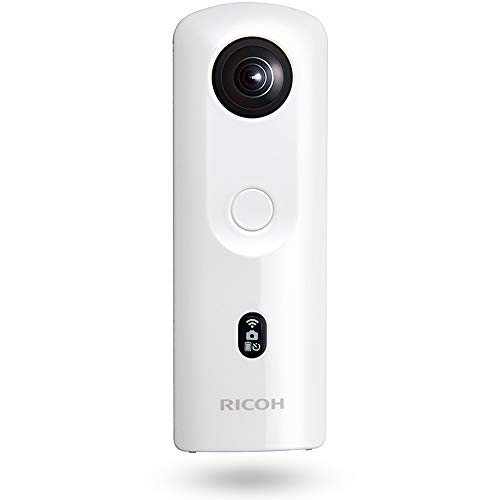
In this post, I'll jot down some quick impressions after using it for a bit.
The Good
First off, you don't have to worry about fitting your subject inside the camera's field of view—there's no need to think about framing at all. The easiest way to put it is that you don't even need everyone to gather together to take a group photo.
When you hear "360° camera," it's tempting to place the camera right in the middle of a big room, but you really don't have to. Unless you're inside some kind of dome where everything you want to see wraps evenly in a circle, most rooms aren't like that anyway, so the results don't look all that different regardless of where you shoot from.
In fact, when you actually look at a 360° photo, it's much easier to view when the interesting subjects are clustered on one side. If four people are sitting around a table, it's better to set the THETA at an empty edge of the table rather than right in the center.
I store my photos and videos in Google Photos. It saves 360° photos without any trouble and even has a built-in viewer. Videos save and play back just fine too. And if I want to share with friends, LINE supports sending and viewing 360° photos natively as well.
The Bad
First, the image quality is lower than I expected. On paper the resolution is 5376×2688, but because that's stretched across a full 360°, cropping in to an angle comparable to a regular photo makes it noticeably blurry. For example, if you zoom in on your face in part of a 360° shot, the drop in detail is pretty obvious. Apparently the higher-end model below is much sharper, though it's way too expensive for me to consider buying.
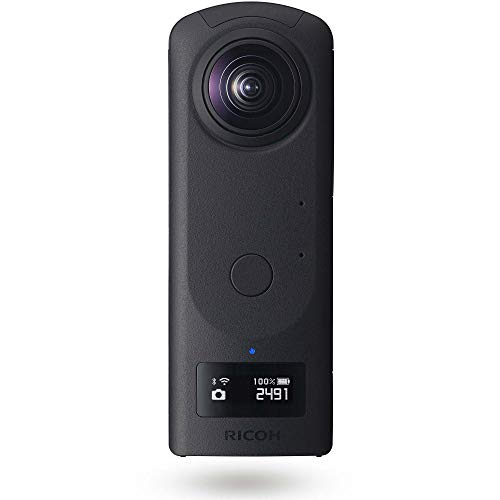
With a regular camera, you can check what you're capturing as you press the shutter, whereas you can't really do that with a 360° camera. You can preview it on your phone, sure, but the screen only shows either a tiny slice of the scene or a heavily warped view. Still, once you take the shot you can check it right away on your phone, so at least it's better than a disposable film camera like Utsurun Desu.
Not really a flaw so much as physics, but the area directly beneath the camera never comes out cleanly. If you're holding it in your hand, your hand and arm naturally block what's below, and even with a selfie stick some of it gets obscured. It's rarely a problem, though if you hold a THETA right over the middle of a dining table full of food, the dishes directly underneath mostly disappear from the shot.
Also, because it captures 360°, unless you hold it straight up overhead, you're pretty much guaranteed to end up in every photo yourself. That might make it awkward if you like shooting pure landscapes to share on social media—not that most social platforms even support posting 360° photos right now anyway.
The THETA series supports plugins, too, though quite a few of them aren't compatible with the SC2's specs—most seem aimed at the higher-end models. A bit of a shame, but it is what it is.
Summary
I keep it in my bag all the time, snap casual shots whenever I go out, and later toss the ones I like into a Google Photos album. I bought a selfie stick bundle too, though I hardly ever carry the stick around.
Because framing is neither necessary nor even possible, it takes away some of the classic craft and fun of photography, yet it's great for casually capturing a moment without overthinking it.
For that kind of use case, starting with the SC2—which prioritizes light weight and fast startup over raw image quality—is definitely the way to go.