
Hooked on the Playdate Handheld Game Console
This article was automatically translated from Japanese by AI. Read the original Japanese version →
Table of Contents
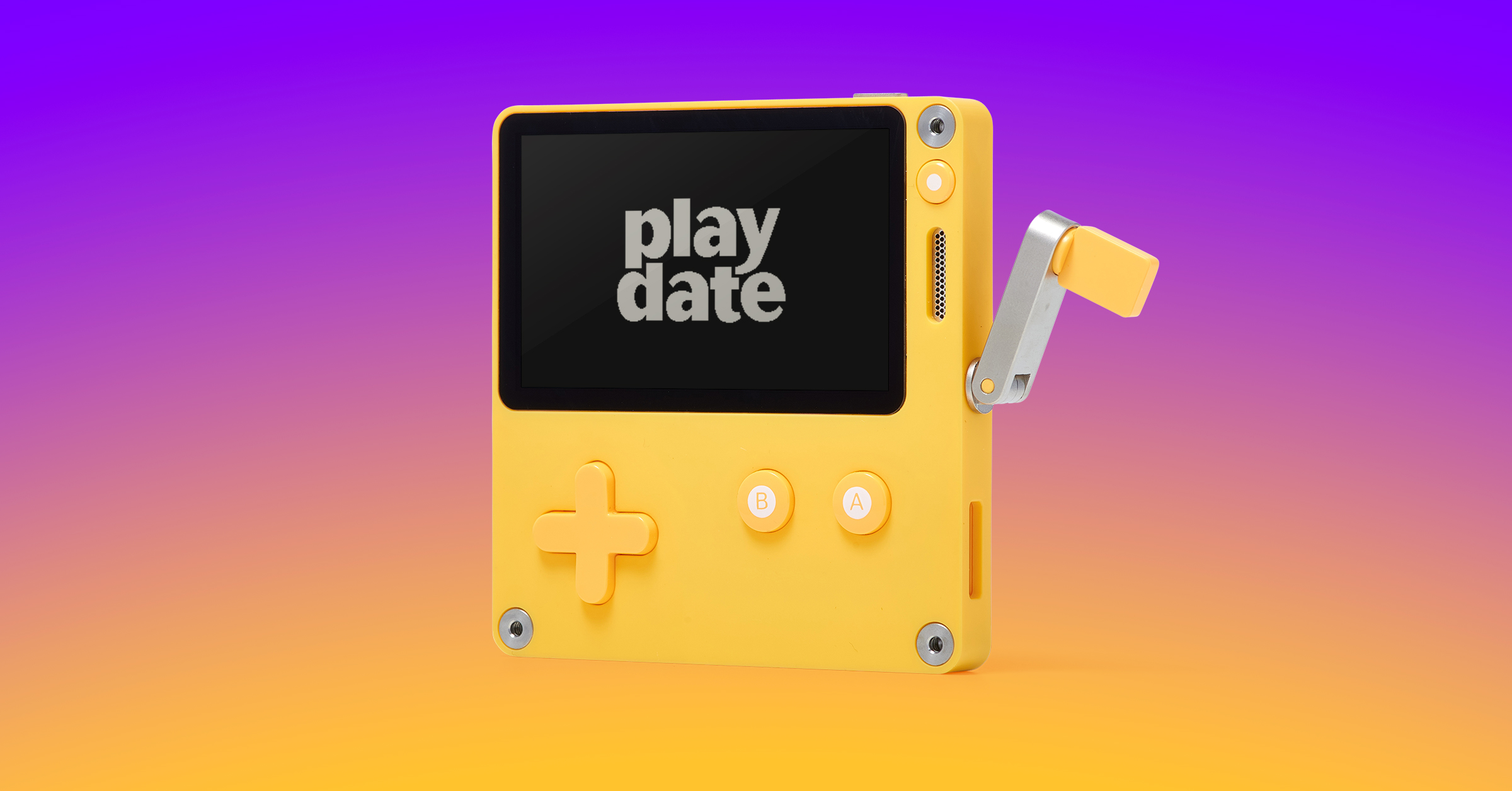
Lately I've been hooked on a tiny handheld game console called Playdate. Ever since mine arrived around September last year (2023), I've been playing some game on this device almost every day, and whenever I take public transit I always toss it in my bag.
To be honest, I hesitated a bit about whether to write this post. Anyone who'd be interested in Playdate probably already owns this device, and I feel like it's really hard to convey its charm through text alone.
Still, I thought there might be some things worth sharing about why I like this device so much, so here I am typing away.
What Is Playdate?
It's a small yellow handheld game console. Think of a square roughly half the height of a smartphone. For controls, it has a D-pad, A/B buttons, a Menu button, and a Sleep button—plus a little rotating handle called a crank. It costs $199, which comes out to around 30,000 yen including shipping.
Buying the console also gets you 24 games included. You can check the lineup on the official site, and it even includes new games from the creators of Katamari Damacy and Getting Over It. Most of the games are bite-sized, but the quality is surprisingly high.
Beyond that, you can buy games on the official store. Prices vary, but most are around $5 to $10. Roughly 10 new games are added every month, so even though it's a niche platform, I don't think I'll run out of games to play anytime soon.
Both the system settings and the games themselves are basically English-only, so it might be tough if you can't read simple English.
Retro Yet Modern
At first glance it looks like an old-school console riding the retro game trend, but it has all the basic conveniences of a modern handheld: downloading games over Wi-Fi, plenty of storage for keeping lots of games installed, sleep and resume, long battery life with a rechargeable battery, and so on. Not strictly a hardware feature, but games also generally auto-save.
It's certainly not high-spec by any stretch, but the games are built without overreaching, so everything runs snappily for a stress-free experience. That owes a lot to the culture of the developer community rather than just the hardware itself, and it's an essential part of what makes Playdate special.
The Vibe of the Lineup
When talking about Playdate, you can't leave out its game lineup or the atmosphere of the developer community making them. Playdate and its community have something about them that makes people want to create and play small, lovely games.
As you can tell from most store titles costing $5–$10, individual games aren't massive in scope. There are lots of arcade-style games where a single run takes 1–2 minutes to chase high scores, and even games with stories or stage-by-stage campaign modes generally let you reach the ending in around 5 hours.
Also, Playdate is purely a handheld—not a home console. Because of that, both developers and players share the same assumptions about what the handheld experience looks like: playing on a small screen, playing in short bursts of spare time, pausing and resuming mid-session, and so on. Developers can design their games with all of that in mind.
That might sound obvious, yet in today's gaming landscape it often isn't.
For example, the Nintendo Switch works both as a home console and as a handheld. That's both an advantage and a drawback. Developers can't assume which setup a player will use. On Switch, it's pretty common to play a scene designed to be savored on a 30-inch+ screen on a 7-inch display during a train commute. Handheld PC devices like the Steam Deck run into the same issue (sometimes the screen just feels too small and hard to read).
Of course, plenty of games don't suffer from that mismatch and are just as fun on a handheld or a big screen, and how someone chooses to play should be up to them, not restricted. Still, I do think that freedom sometimes unintentionally compromises the experience.
Because Playdate is strictly a handheld, developers and players share the exact same screen, speaker, and controls. Playing on Playdate makes me feel like there really is a distinct comfort born from that shared baseline.
How the Crank Feels
A crank is an unusual mechanism for a game controller, and in practice it turns out to be a great fit for games.
Watching a video will give you a much clearer idea than me trying to explain it in words.
Here's gameplay footage of "Root Bear," where a bear pours just the right amount of root beer (drinkable icy-hot patch) for customers pic.twitter.com/hXhOjaejbu
— Nore139 (@Nore139) November 23, 2023
Summary
So, that was a long ramble about Playdate.
Playdate is a curious little console. Even though lots of different developers are making and selling games for it, the lineup feels like it shares a consistent direction. On top of that, there's almost a shared philosophy or aesthetic binding the whole community of developers and players together.
There's no end to the other things I love about it too: the crisp feel of high-detail pixel-art animations, the sharp and smooth black-and-white screen, a speaker that sounds surprisingly good, the unique tactile feel of the crank, the cheerful, cohesive design, and the solid build quality.
It used to take months after ordering, but production seems to have finally caught up—now it looks like it ships in just a few weeks. If this caught your interest, definitely consider picking one up.